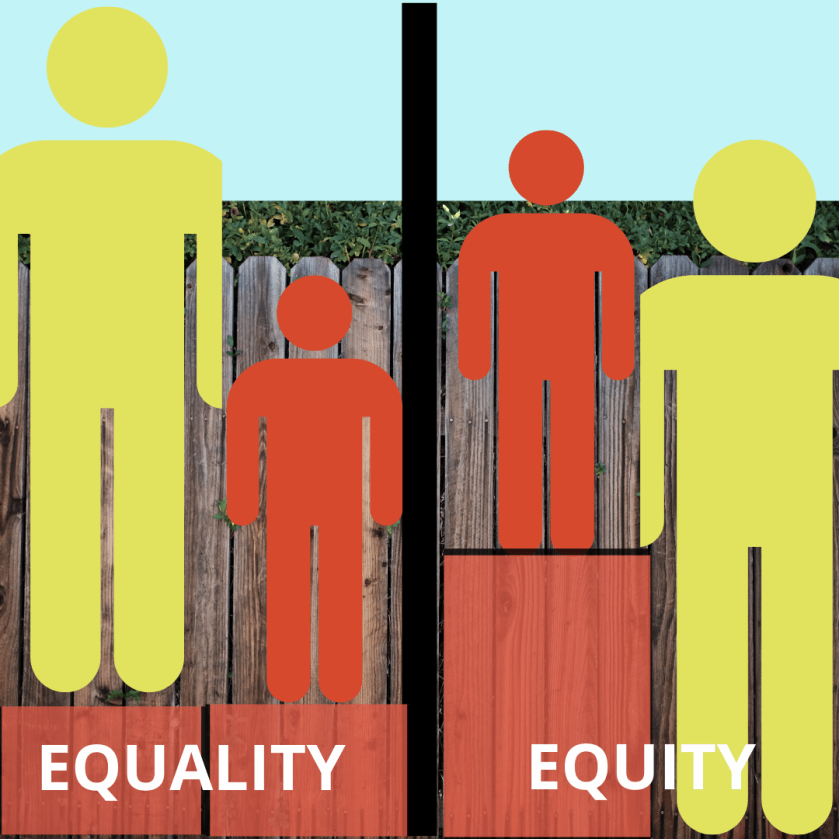
I have always thought of equality as important and a necessity. I do believe that everyone deserves to be treated as an equal – in status, rights and opportunities.
But the fact is, that most of us have different opportunities because we do not start off on equal footing. We all have our own set of advantages and disadvantages which give us a leg up compared to someone else.
It is because of this that equality is simply not enough in healthcare. While the idea of dividing already scarce resources evenly across the board sounds fair in principle, is it fair to say that a child born with Cerebral Palsy should get the same allocation (think funding in terms of healthcare) as one without CP?
As such we have Equity.
And in equity we look more at how resources are distributed as opposed to how we can get the most benefit from it.
Equity basically revolves around the principles of justice and fairness. This assessment of fairness is subjective. In equity we are going to say that more money should be given to the child with Cerebral Palsy because we can argue that to have the same quality of life as a child without CP they need more assistance, special equipment and that naturally incurs more costs.
This of course could be said to not be efficient.
So efficiency has many forms – from getting the most value for money, the most amount of output from a single input to reducing wait times in healthcare.
So which do we choose – equity, equality or efficiency? Here’s another example.
When I was in Sabah (Borneo), I worked in the main tertiary referral centre. While it was great and I learnt a lot, one of the biggest issues our patients had was in accessing healthcare because of costs, distance, lack of public transportation and the lack of equally equipped healthcare facilities close by.
While I can understand that concentrating all our efforts into one main centre is more cost effective, spreading it out and equipping other units to cope better would make my patients lives a lot easier.
Is it an efficient use of our resources? Probably not, but it sure would make me feel a lot better and in this scenario I think most of you would agree. Let’s go back to the child with CP though.
Now, if we did not practice equity and went on equality (everyone gets the same) would the argument then be that the child without CP would have an added advantage and therefore and even better quality of life?
Does this then make it more efficient as a whole? Or does the negative quality of life experienced by the child with CP who got less than they would if things were equitable, counter the ‘apparent advantages’ seen and we are right back where we started?
What do you think?

 365 days of public health
Given that there is no ethically acceptable reason as to why one person should flourish more than the other, we have to strive towards equality of heath.
In delivering healthcare we need to take into account the initial states of health of different people and their capacity to benefit from the intended initiative. I thus see equity as a consequence.
I view efficiency as a function of this process. In delivering efficient healthcare, we need to first, clearly define, within our own context, equality of health (health outcomes) and equity (delivery output). There needs to be the architecture in place to collect data on determinants of equality and equity, as well as policy targets guided by a combination of empirical evidence as well as these databases.
I think we are on the right track, and while there will be trade-offs between efficiency and equity, I am going to try and not overthink it and just be as useful as I can within the system.
Keep at it Prav, really excited to see where this journey takes you.
LikeLiked by 1 person