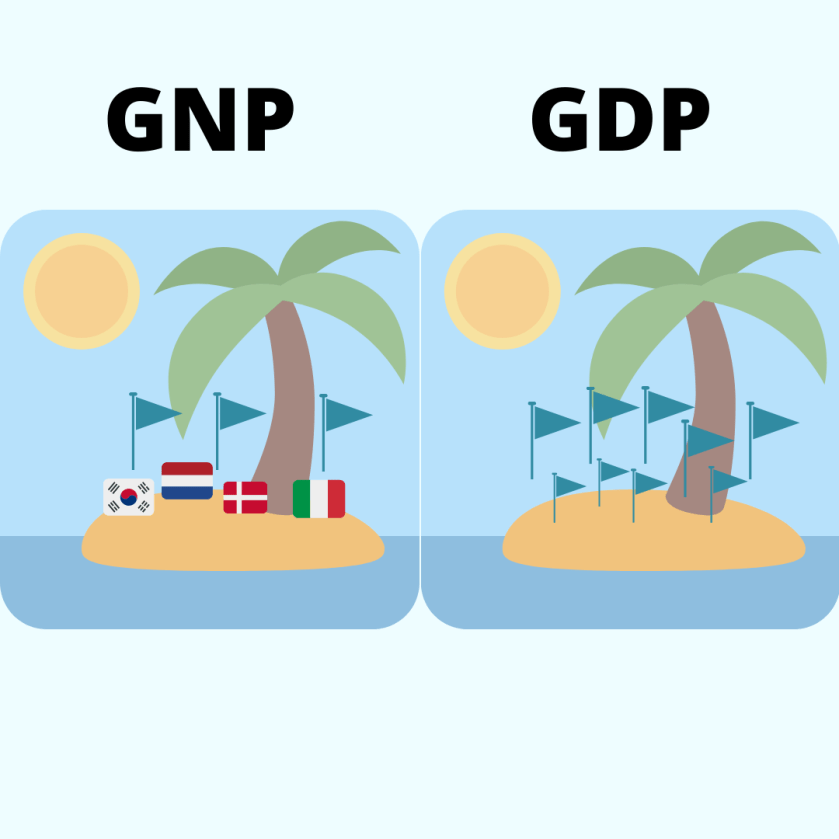
What do all the countries above have in common?
They have the highest GNI per capita in the world.
Let’s take a step back though, the first thing we need to understand is economic growth.
Economic growth is when we see an increase in the goods/products/services produced over a period of time. It is good to note that it is inflation adjusted.
So GDP or Gross Domestic Product is how we measure it. Basically it tells us the output or production of a country, regardless of who has made the product. This tells us how healthy the economy is but does not really clue us in into the financial well being or wealth of the people or the country itself.
GNP is Gross National Product which is the same as Gross National Income. Regardless of which term you choose, the concept is the same. Both measure the production/income of a country and all it’s people, regardless of whether it is within their borders. Think of GNI as GDP + salaries and other incomes of the country’s residents earned abroad.
For example Amazon is a US based and owned company, although it is operating in the UK/Malaysia/*insert country of choice* it contributes to the GNI/GNP of the United States while contributing to the GDP of the UK.
But how does that help us understand the wealth/well-being of a country? Surely Amazon is not a reflection alone of the USA being a wealthy country?
Hence we have GNI/GNP per capita which is essentially the average income of a country. We take the entire income by people from/in the country and divide it by the total population. This allows us to draw comparisons between different countries regardless of population size and tell us what their income is which is used by the World Bank to classify countries into low, middle and high income countries.
However, this does not reflect the economic situation of a country as it is the average and as we are all too familiar with, wealth is not distributed equally across the board. Therefore it says nothing about the standards of living for the entire population involved. For this reason, it cannot be used on its own.
So how do we overcome this and get a better idea of what is going on in each country? More in the next post.




 365 days of public health