Red Pill or Blue Pill – Randomised Controlled Trials

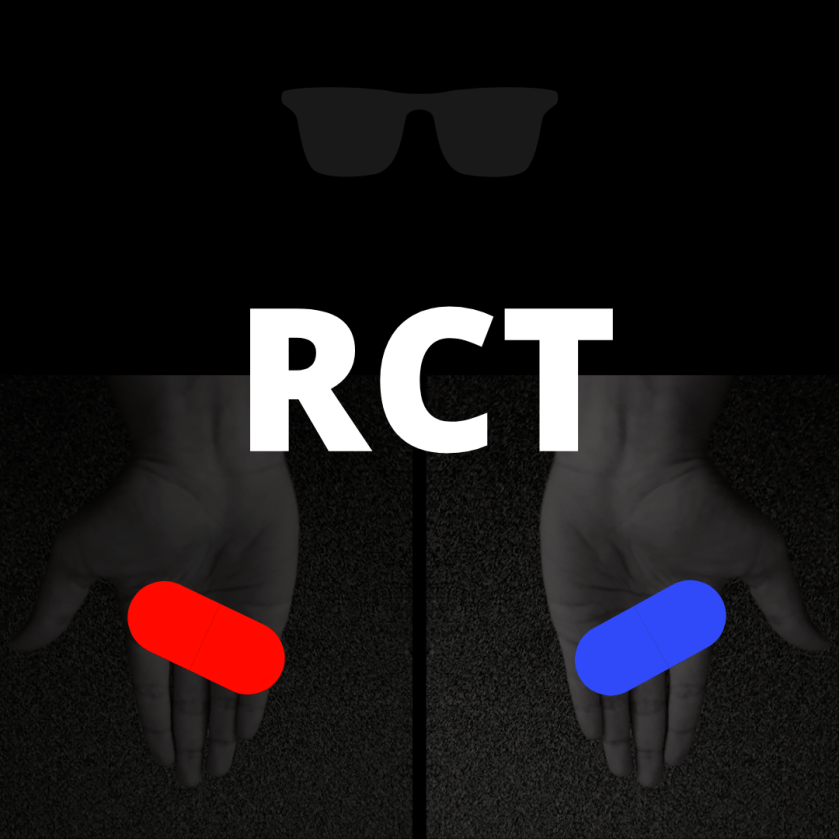
Remember that iconic scene in the matrix where Morpheus asks Neo to choose the red pill or the blue pill? That’s how I like to think of RCT’s.

Basically the researcher is “Morpheus” and the study subject is “Neo”, but instead of just 1 Neo choosing the red/blue pill we have a few. Each Neo is randomly assigned either the red or blue pill. Morpheus then sits back and watches what happens to the Neo’s and we see by the end of it who is more content – the Neo living life in blissful ignorance in the Matrix or the one steeped in reality.

Which is basically what RCT’s do. They assess how different interventions/treatments affect two different groups by following up participants. When done well, it provides the best evidence on the cause and effect relationship by studying it in real time. (temporal sequence)

There is an experimental group given the intervention/treatment (Neo leaving the Matrix) and the comparison group (controls) that gets a placebo or the current conventional treatment (Neo in the Matrix). They are then followed up to assess how effective the new intervention/treatment is in comparison to the current standard/placebo group. (Is Neo more content out of the Matrix or in?)

However unlike Neo in the Matrix, there is no choice involved and the individuals involved are randomly assigned.

Why? To avoid any selection bias by the testers choosing individuals who may have better outcomes and to ensure that both groups are as similar as possible therefore being able to distribute the confounding factors.

What are confounding factors?
It is basically any other variable that can affect your dependent variable.

For example, if we are doing a study on a sedentary lifestyle causing weight gain. The independent variable here is the sedentary lifestyle while the dependent variable is weight gain. And the confounding factors can be anything from stress, diet, food portions, genetics and metabolism – all of which can affect weight gain (dependent variable). The hope is that by randomising it, we will get an equal amount of these other confounding factors in every group therefore giving us a clearer picture on the intervention being studied.

Despite being the best method, RCT’s still has some short-comings. They tend to be expensive, time consuming and you could argue that if a person is in an RCT – they are probably more likely to be compliant therefore not really giving us a real world experience.

Opportunity costs

In Disease Detectives, I talked about the utilisation of limited resources.

So the question is what factors come into play when making decisions about what are the best possible interventions/actions we should take.

Opportunity costs is one of those factors.

In healthcare our main issues are

  1. How do we get the best outcomes
  2. How do we reach the most amount of people
  3. How do we keep costs low or within the scope of the resources available

And this of course means we always have to make choices, and opportunity costs is one of the guiding factors in this decision making process. So what is opportunity costs?

It is basically the potential good outcome that is lost by the utilisation of resources or efforts in another area/intervention.

What on earth does this even mean?

The easiest way I understand this is in terms of hospital beds (in wards) and primary health care centres (outpatient/GPs).

So let us say we figure out that if one person is admitted in hospital, the same amount of funds could have been allocated to treating 15 people in a GP setting. So this is an opportunity cost because by having that one bed/admission, we lose the funds to treat 15 people in an outpatient setting.

And if I relate it to paediatrics, for every child admitted to ward requiring their parents to take time off work – that time spent in the hospital with one child also means a missed activity with other family/children or even wages lost .

Why is this important?

Because it shows us that requiring admission for treatment really should be a last resort and that it would be more cost effective if we could reduce the number of admissions.

So the next question is how do we figure out which is the best way to do that?

365 days of Public Health?

Hi there.

Welcome to 365 days of Public Health!

I’m Praveena and I am a medical doctor with an interest in Paediatrics and of course, Public Health.

I decided to start start 365 days of public health for three reasons.

1) I am pursuing my MSc in Public Health with the London School of Hygiene and Tropical Medicine by distance learning and I think this is a good way for me to hold myself accountable and keep up to date with my course every single day.

2) When I said I wanted to pursue my MSc in Public Health a lot of people (both medics and non medics) did not understand why. I then realised that there are a lot of people who do not really understand what public health is about and what it entails. So I am hoping that this blog gives you a glimpse into some of the principles and concepts involved in public health and why it is such an important part of our lives. While I will cover my curriculum, I will also put forth bits and bobs that I find interesting about public health and the work that is done in the field.

3) And of course I am hoping that through this blog I get to meet other individuals in and out of the field who will hopefully teach me a thing or two along the way.

Cheers!

Praveena
P.S – I know 2020 is a leap year, but I figure we will stick with 365 since the school year only started in Sept/Oct anyway.